Three places where glass mists up and what it tells us
When a window mists up, the first question is whether the glass is faulty. The answer depends on where the moisture is. Only one of the three places points to a genuine fault.
First, look at where the moisture is
Misted glass is not always a sign that something is wrong. Moisture can appear on the outside, between the panes or on the inside, facing the room. Each place means something different, and only one of them is a fault in the glass.
Glass surfaces are numbered from the outside in. On triple glazing these are surfaces 1 to 6: surface 1 is the outer face, surface 6 faces the room, and surfaces 2 to 5 are inside the insulating glass unit.
Surface 1 · outside, in the morning: the glass insulates well
A good insulating glass unit keeps the heat inside, so the outer pane stays as cold as the outside air. In the morning, after a clear, damp night, dew forms on it, just as it does on grass or on a car.
It is most common in spring and autumn, on triple glazing and roof windows. It clears by itself once the sun warms the air.
Neighbours with old windows do not see it, because heat escapes through their glass and warms it. External condensation is proof of good insulation, not a fault.
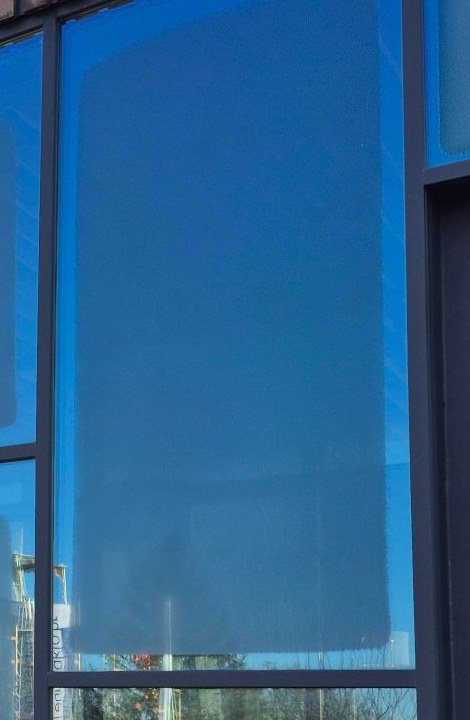
Dew on the outside of triple glazing on a winter morning. Along the edge, where a little heat passes through the frame, the glass stays clear. Condensation on the outside means the heat is staying in.
Surfaces 2 to 5 · between the panes: this is a fault
An insulating glass unit is hermetically sealed and filled with dry air or gas. Moisture between the panes means that the edge seal has failed or that the desiccant in the spacer can no longer absorb moisture.
In a triple-glazed unit each of the two cavities is sealed separately, so the moisture can be in either of them. It condenses on the colder pane of the cavity: in winter on surface 2 or 4, and when it is colder inside than outside (in summer, with air conditioning) on surface 3 or 5.
It cannot be wiped off from either side and will not clear by itself. This is rare today, but when it happens, the unit has to be replaced.
The most common causes are water standing in the window rebate and acetoxy silicone on the edge. More in the article Insulating glass units: installation, sealants and storage.
Surface 6 · inside: too much humidity in the room
Warm, humid air from the room reaches the colder glass and leaves droplets on it, like on a bottle taken out of the fridge.
With today’s insulating glass this is rare. In a room at 20 °C and 50% relative humidity, old single glazing mists up as soon as it is +9 °C outside. An insulating glass unit with a Ug of 1.1 only when it is −48 °C outside, in other words practically never.
If a new insulating glass unit does mist up on the inside, the cause is humidity in the room: cooking, drying laundry, a bathroom, a swimming pool or a new build, where the plaster and screed dry out over the first winter. The glass is not to blame.
Misting on the inside, on surface 6: what helps
Short, thorough airing: open the window wide for a few minutes, several times a day. A window left permanently on tilt cools the wall without getting rid of the moisture.
Air must reach the glass. A curtain, blind or deep window board that closes off the glass keeps it colder, so it mists up sooner.
The edge of the glass is the coldest part. If it mists up only along the bottom edge, the edge of the unit is the cause. A warm edge spacer (plastic instead of aluminium) keeps it warmer. More in the glossary under Ψ.
Send us your opening schedule
or a project brief.
We reply with a quote and a technical data sheet, and on request a specification clause for your bill of quantities.